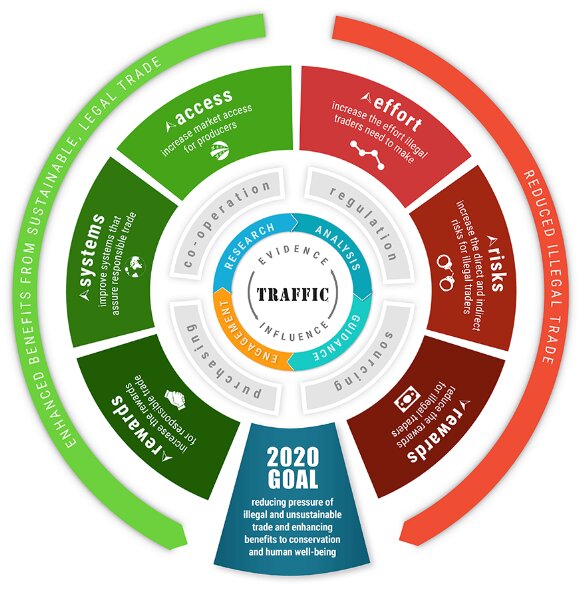
The TRAFFIC, the Wildlife Trade Monitoring Network, is a leading non-governmental organisation working on wildlife trade in the context of both biodiversity conservation and sustainable development.
It is a joint program of World Wildlife Fund (WWF) and the International Union for Conservation of Nature (IUCN).
It aims to ensure that trade in wild plants and animals is not a threat to the conservation of nature.
It was established in 1976 and has developed into a global network, research-driven and action-oriented, committed to delivering innovative and practical conservation solutions.
Headquarters: Cambridge, United Kingdom
Illegal wildlife trade is one of the main reasons that many species are endangered.
How is it Governed?
The TRAFFIC is governed by the TRAFFIC Committee, a steering group composed of members of TRAFFIC's partner organizations, WWF and IUCN.
Its staff includes experts from a plethora of backgrounds: biologists, conservationists, academics, researchers, communicators or investigators, etc.
What are the Functions Performed by TRAFFIC?
Since its establishment, it has helped in the evolution of the international wildlife trade treaties.
It focuses on leveraging resources, expertise and awareness of the latest globally urgent species trade issues such as tiger parts, elephant ivory and rhino horn.
Large scale commercial trade in commodities like timber and fisheries products are also addressed and linked to work on developing rapid results and policy improvements.
TRAFFIC and India: What is the Scenario?
TRAFFIC operates as a Programme Division of WWF-India, based in New Delhi since 1991.
It has since worked closely with the National and the State Governments and various agencies to help study, monitor and influence action to curb illegal wildlife trade.
Bridging the gap in effective wildlife law enforcement in India through capacity building programmes:
Under this programme, TRAFFIC provides training and inputs to a diverse group of officials working on wildlife enforcement and other related issues.
Conducting research and providing analysis on wildlife trade and its trends:
TRAFFIC India’s on-going projects include study on Leopard and Tiger poaching and trade in India, peacock feather trade, owl trade, dynamics of hunting community, trade in medicinal plants, bird trade and more.
Awareness generation:
“Don’t Buy Trouble” is one of TRAFFIC India’s first consumer awareness campaign that advises tourists to be careful of what they buy as souvenirs during their travels.
The campaign has been running successfully since 2008 at airports, Tiger reserves, national parks, wildlife resorts/hotels, travel agencies, schools, colleges and other prominent locations.
TRAFFIC’s latest campaign is the WANTED ALIVE series on the four Asian big cats- Tiger, Leopard, Snow Leopard and Clouded Leopard—all of them threatened by illegal trade in their body parts.
Encouraging international collaborations to fight wildlife crime:
TRAFFIC played a key role in bringing together the South Asian countries to form the South Asia Wildlife Enforcement Network (SAWEN).
SAWEN was formally established at an inter-governmental meeting hosted in Paro (a town in Bhutan) by the Royal Government of Bhutan, in January 2011.
The main aim of this initiative is to have the countries collaborate and cooperate to fight wildlife crime in the region.
These are some of the priority issues and areas of intervention identified by offices in the Asia Pacific Regional Network:
Food/Water/Energy security for resource dependent and vulnerable communities.
FPIC and social safeguards.
Regional and global advocacy processes (CBD, Post-2015 agenda and SDGs).
Equitable access to natural resources, environmental governance, sustainable and customary land use.
Engagement with civil society and building larger constituencies in support of sustainable development.
Social impact and well-being indicators, better social and economic measures.
Social dimensions of Green Economies, building resilient rural economies.
Post a Comment
0
Comments
What's so special about
October 4
On this day in 1957 the Soviet Union launched Sputnik 1, the first artificial satellite, which orbited Earth until 1958, inaugurated the space age, and heightened Cold War competition between the U.S.S.R. and the U.S.
Thought of The Week
02/10/22 -- 08/10/22
In every day, there are 1,440 minutes. That means we have 1,440 daily opportunities to make a positive impact.
-Les Brown




0 Comments